ECR Training Workshop
Measuring proteostasis using quantitative proteomics: A hands-on workshop on protein turnover and ubiquitylation
Tue 3rd – Wed 4th November 2026
Liverpool John Moores University
Led by Professor Jatin Burniston
Registration for this event has now closed
Workshop Overview and Description:
Quantitative proteomic techniques, employing mass spectrometry, offer opportunities for studying proteostasis in a comprehensive and non-targeted manner. When combined with stable isotope labelling, these techniques can also measure the turnover rates of proteins alongside changes to their abundance and post-translational modification status.
This workshop aims to introduce delegates to proteomics in the context of proteostasis research and focuses particularly on the analysis of protein turnover and ubiquitylation. During the 1.5-day workshop, delegates will receive bench-to-results training, including hands-on experience using Ubiquitylomics by Stringent, Cleavable, Affinity-based Proteome Extraction (Ubi-SCAPE) and practical experience analysing proteomics data in R with consideration on quality control for protein abundance, protein-specific turnover rates, and the scoring and interpretation of site-specific modifications.
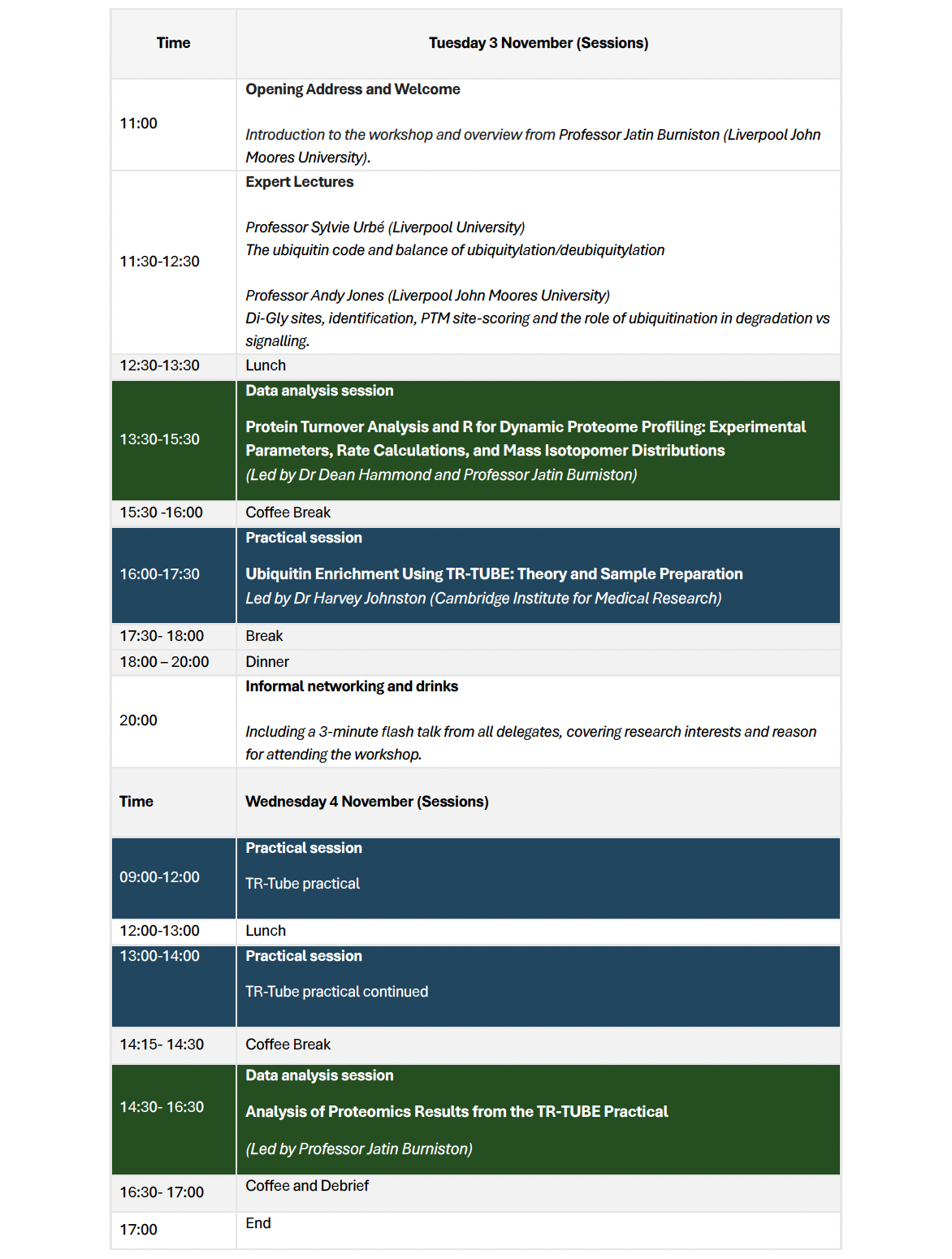
The workshop includes expert lectures from Professor Sylvie Urbé on how chain topology and the ubiquitylation–deubiquitylation balance set the meaning of a ubiquitin mark, and Professor Andy Jones on identifying, scoring and interpreting di-glycine remnant sites, and why many reflect signalling rather than proteasomal degradation. Dr Harvey Johnston, who developed Ubi-SCAPE, leads the wet-lab practical on polyubiquitylation enrichment. Professor Jatin Burniston and Dr Dean Hammond will lead attendees through the experimental requirements for protein turnover measurements and the analysis of proteomics data in R.
Specifically, the workshop aims to provide:
- Practical data analysis skills in R, including protein abundance profiling, the calculation of protein-specific turnover rates and scoring of site-specific post-translational modifications.
- Hands-on wet-lab experience in the preparation of complex biological samples for peptide mass spectrometry and specifically the Ubi-SCAPE trypsin-resistant tandem ubiquitin binding entities (trTUBEs) workflow (click here find out more information on this new method).
After completing the workshop, attendees will be able to:
- Understand how mass spectrometry is used to study abundance, turnover rate and post-translational modification in complex samples.
- Appreciate the intricacies of leading research on the role of protein turnover and ubiquitylation in the context of proteostasis.
- Apply fundamental principles of proteomic data analysis in R.
- Apply dynamic proteome profiling and the Ubi-SCAPE laboratory method in the context of their own research.
Who should attend?
This training workshop is aimed at all early career researchers (including, but not limited to, PhD students, postdoctoral researchers, and early-career group leaders).
No prior experience of Mass Spectrometry is required or knowledge of programming, although both would be helpful.
The Proteostasis UK is committed to building a research community that reflects the full diversity of talent in the field. We particularly encourage applications from early career researchers who are under-represented in proteomics and the wider life sciences, including women, Black, Asian and minority ethnic researchers, disabled researchers, and those from other backgrounds under-represented in academic science. All applicants are assessed on merit against the same criteria. If you have any access requirements or would need support to participate fully, please tell us and we will work with you to make that possible.
EDI Support grants are available to help cover additional costs associated with caring or childcare responsibilities and accessibility requirements. For more information and to apply, please see: Proteostasis UK EDI support grants
Provisional Programme
Registration
Registration for this event has now closed.
This workshop is free to attend. All training materials, resources, refreshments, and meals will be provided. Please note that participants are responsible for arranging and covering the cost of their own travel and accommodation.
We encourage participants to explore travel grant opportunities to support their attendance at the workshop, including:
The Biochemical Societies Travel Grant (Deadline for the next round of applications is 1 September)
Honor Fell / Company of Biologists Travel Awards (Apply at least six weeks before the event)
This workshop is provided by Proteostasis UK which is supported by BBSRC funding.
Important Information:
Capacity is strictly limited to 20 attendees.
Selection will be based primarily on applicants’ motivation to attend the workshop and the extent to which they would benefit from participating.
Registration will close on Friday14 August and those selected to attend will be notified by Friday 21 August. This registration round is intended to give participants sufficient time to apply for travel grants to attend the workshop.
All attendees are expected to arrive for registration on Tuesday 3 November and remain until the final session.
Eligibility Criteria
Applicants must:
* Be a member of Proteostasis UK. If you are not already, sign up here.
* Be based at a UK institution or organisation
* Self -identify as an early career researcher (ECR)
Venue
Liverpool John Moores University is a leading modern university with a strong reputation in the life sciences, combining high-quality research with a practical, impact-focused approach to biological and biomedical sciences.
Liverpool John Moores University's Byrom Street Campus is situated in the heart of Liverpool city centre, within easy walking distance of Liverpool Lime Street station and many of the city's cultural, retail, and waterfront attractions.
Camus Location: Liverpool John Moores University, James Parsons Building, Byrom Street Campus, Liverpool, L3 3AF
Travelling to Liverpool
Liverpool is easy to reach, with plenty of travel options for getting to the city and to LJMU.
We recommend travelling to Liverpool by sustainable public transport. The city benefits from excellent rail connections to many major UK cities, with frequent direct services operating to Liverpool Lime Street Station throughout the day.
Please follow this link for more information: https://www.ljmu.ac.uk/contact-us/find-us
Please note that no parking provision is available for workshop participants.
Accommodation
Premier Inn Liverpool City Centre (Moorfields) hotel (3 Vernon St, Liverpool L2 2AY)
~16 mins walk from Liverpool John Moores University ~£60-80/ night.
See here for more information: https://premierinn.com/gb/en/hotels/england/merseyside/liverpool/
Travelodge Liverpool Central (25 Old Haymarket, Liverpool L1 6ER)
~ 17 mins walk from Liverpool John Moores University ~£40-50/ night.
See here for more information: https://www.travelodge.co.uk/hotels/149/Liverpool-Central-hotel
DoubleTree by Hilton Hotel & Spa Liverpool hotel (6 Sir Thomas Street, Liverpool, L1 6BR)
~ 20mins walk from Liverpool John Moores University. ~£150-200/ night.
See here for more information: https://www.hilton.com/en/book/reservation/rooms/
If you have any queries about this event, please email proteostasisuk@babraham.ac.uk
We look forward to welcoming you to the workshop!